Self-sacrifice
The Giving TreeSelf-sacrifice in The Giving Tree is the tree’s repeated surrender of her own resources to meet The Boy’s changing needs. Apples, branches, and trunk pass from her to him as money, a house, and a boat; by the final return, she has nothing left to give except the stump itself as a quiet place to rest. The story makes devotion concrete in these transfers, but its recurring declarations that the tree is happy sit uneasily beside her loneliness, sadness, and progressive diminishment.
A Pattern of Giving
The exchange begins after time has gone by, The Boy has grown older, and the tree is often alone. When he returns, she invites him to climb, swing, eat apples, play in her shade, and be happy. He answers that he is too big for those childhood pleasures and wants money to buy things and have fun. The tree has no money, she says, only leaves and apples, and she offers the apples for him to sell in the city. The offer turns her limited possession into a resource for his new purpose: she cannot provide money directly, but she can relinquish what may produce it.
The Boy climbs the tree, gathers her apples, and carries them away. The action is brief, but it establishes the pattern that governs their later encounters: he names a need, and the tree identifies something of hers that can answer it. The narration says that she is happy after the apples are taken. Yet the happiness is not the same as an equal exchange; what is explicit is the transfer of her fruit and his departure with it. After a long time, the tree is sad, and only then does he come back. The contrast places the emotional cost of giving beside the apparent satisfaction it brings her.
Gifts That Alter the Tree
The next request is for a house. The Boy says he wants a wife and children and therefore needs a home. The tree has no house to give: the forest is her home. Still, she offers her branches so that he can build one and be happy. Her answer treats even the place where she lives not as a limit on what she may give, but as material that can be surrendered for his domestic future.
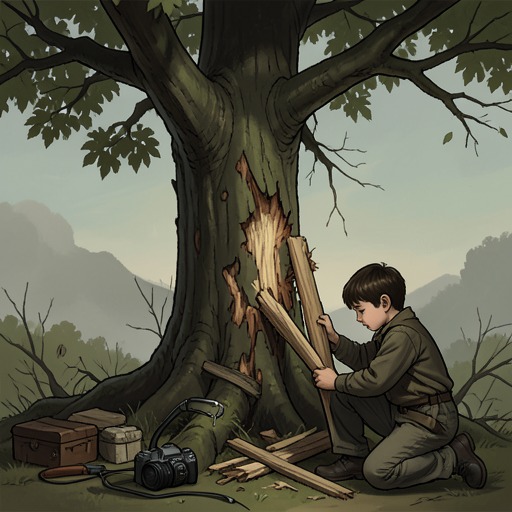
The Boy cuts off the branches and carries them away to build his house. Again the tree is described as happy, and again the gift changes her condition: the branches that once enabled the invitation to climb and play are gone. After a long time, The Boy returns, and the tree is so happy she can hardly speak. She whispers an invitation to play. The scene brings the earlier language of childhood back into a changed relationship: the tree still offers play, but the branches that made swinging possible have already been given up.
Later The Boy asks for a boat. The tree tells him to cut down her trunk and make one, so that he can sail away and be happy. This gift is more final than the earlier ones. The Boy cuts down the trunk, makes a boat, and sails away; what was the tree’s central body becomes transport for his departure. The narration says she is happy, but immediately qualifies that judgment: “but not real y.” The qualification interrupts the repeated formula and makes the difference between the tree’s stated happiness and the cost of the gift impossible to overlook.
Need, Loss, and the Last Offering
By the time The Boy returns again, the losses have accumulated. He says his teeth are too weak for apples, and the tree’s branches are gone; she points out that he cannot swing on them. The exchange recalls the earliest offerings while making clear that the resources once used for play and food are no longer available. Self-sacrifice has not simply supplied successive needs; it has changed what the tree can offer and what kind of relationship remains possible.
The tree says she wishes she could give him something, but has nothing left and is just an old stump. She apologizes. Her description gathers the consequences of the earlier gifts into a stark inventory: apples gone, branches gone, trunk gone, and only the stump remaining. The Boy, now tired, says he does not need very much, only a quiet place to sit and rest. His need is no longer for money, a house, or a boat; it is for a place suited to his present weariness.
The tree straightens herself as much as she can and tells him that an old stump is good for sitting and resting. She invites him to sit down and rest, and the story ends by saying that the tree is happy. The final gift is not a detachable possession but the remaining form of the tree herself: the stump becomes useful as sheltering support without being cut away for another purpose. Her capacity to give persists after the earlier resources are exhausted, though the terms of that giving are now determined by her diminished state and his reduced need.
What Self-Sacrifice Means in the Story
The sequence gives self-sacrifice a material shape. Each time The Boy names an aim, the tree offers something specific that can help realize it: apples for money, branches for a house, trunk for a boat, and finally the stump as a place to rest. The gifts are not abstract expressions of affection; they remove or transform parts of the tree. Their consequences remain visible in the next return, so that the story’s pattern of generosity is also a record of accumulating loss.
The relationship is strikingly asymmetrical in the scenes shown. The Boy asks for what he needs, and the tree proposes what she can give; the narrative does not depict him replacing the resources or offering something comparable in return. At the same time, the tree’s repeated happiness is part of the evidence, not a simple measure that erases the cost. Her loneliness after The Boy leaves and her sadness during his absence complicate the refrain, while the qualification after he sails away most clearly unsettles it. The story holds pleasure in giving and depletion together rather than making them equivalent.
The passage of time changes both the requests and the form of care. The Boy grows older and returns after long intervals; his desires move from money and enjoyment to a house, then a boat, and finally a quiet place to sit. The tree’s gifts move in the opposite direction, from fruit and branches to trunk and stump. In the ending, self-sacrifice is both the lasting structure of their bond and its visible cost: the tree has been reduced almost entirely, yet she can still welcome The Boy and provide the rest he asks for.